
The Daily Telegraph has an interesting retrospective of photos of UFOs going back to 1870. This one was seen over New York in 1950. Looks like a brandy snap to me.
The Daily Telegraph has an interesting retrospective of photos of UFOs going back to 1870. This one was seen over New York in 1950. Looks like a brandy snap to me.
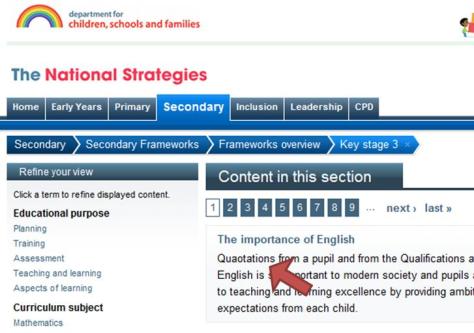
This document on the Department for Children, Schools and families website has a very embarrassing mistake, made all the more ironic because it is about standards in English.
The 10th October edition of the Forest & Wye Valley Review, a local free newspaper, has an article reporting triangular black craft seen by anonymous witness over the A40 dual carriageway next to Chippenham Mead at 10 PM on Friday 26th September.
The witness describes the two objects as “low enough to hit with a stone… There were several lights on them, arranged symmetrically on the underside and there were white lights on the three points of each triangle.”
Moving “slower than 5 mph” they took at least 15 seconds to pass over the dual carriageway. They were “absolutely silent and there were no other cars on the road at the time”.
The witness provides a sketch showing craft very similar to the ominous black triangles that have featured in so many UFO sightings in recent years.
The article appears to have flushed out others who have seen similar craft. The 17th October edition has a front page article reporting similar sightings in Westbury last winter and Whitchurch in 1994.
Perhaps it was all a big fib.
Perhaps it looked a bit like this triangle filmed over Florida in March:
“We call our islands by no less than six different names, England, Britain, Great Britain, the British Isles, the United Kingdom and, in very exalted moments, Albion. How can one make a pattern out of this muddle?”
George Orwell, The Lion and the Unicorn
This BBC News article, combined with a recent visit to the USA reminded me of the misunderstanding that exists in the minds of not just Americans and others but – embarrassingly – English people about when to use the word words England and English. I should stress that I don’t believe it’s malicious; more a bad habit whose avoidance can prevent giving offence to those born in the constituent countries of the United Kingdom of Great Britain and Northern Ireland outside England. I also stress that I’m no constitutional expert: my own qualifications are merely having been born in England and living in Wales.

In short England is used wrongly to refer to the sovereign state whose formal name is the United Kingdom of Great Britain and Northern Ireland. This misuse went on in political circles until relatively recently, with Winston Churchill speaking during World War Two of ‘England’ when he was referring to the aformentioned sovereign state. Or was he? There’s an essay for a first year PPE student.
Recent devolution of some government powers away from the United Kingdom government and parliament in Westminster to Northern Ireland, Wales and Scotland have served to make this issue more important to handle sensitively.
My guide for the uncertain:
I spotted this angle on some skyscrapers while being jostled by Seattlite commuters during the evening rush hour.
A photo taken from the Bainbridge Island Ferry.
On holiday in the Seattle area, I spent yesterday walking around the centre of the city and, after a lunch of clams and fish and chips, took a ferry across Puget Sound to Bainbridge Island.
After a visit to a bookshop, I was stopped by a member of the American Civil Liberties Union. He was looking for support for among other things, their campaign to close the POW camp at Guantanamo Bay. I explained that I was a foreign tourist, but he said that he had signed up someone from Australia recently. While I, in broad terms, agreed with the ACLU’s stance, I couldn’t bring myself to contribute to an organisation involved in political struggles in a country that is not my own. I meekly offered a link to the ACLU on my blog as a sort of substitute.
Before I went on my way, he offered me an apology on behalf of his country for its foreign policy mistakes in recent years.
I think cycling is a good thing: healthy, environmentally sound, cheap etc. Cyclists rightly complain that roads are not designed to accommodate their needs and risk their lives daily by peddling unprotected among tons of high speed metal objects, that is to say cars and lorries.
But then they spoil it by cycling on the pavement and expecting pedestrians to get out of their way!
This has come to my attention recently on the Wye Bridge in Monmouth where cyclists regularly push past me on the pavement (for American readers, the sidewalk) heading into the town centre. These aren’t just kids who should know better either: these are foursomes of hard core übercyclists with their fancy skin tight shirts and helmets, decked out in the proper gear for a day out on their bikes.
If you are one of those cyclist who doesn’t bother to obey the Highway Code and get off your bike when on the pavement you shouldn’t be surprised if you begin to lose the respect of other road users.

I walked from Monmouth to Tintern along the Wye Valley today and took this at Bigsweir, half way between Wales and England.
Musings on biblical studies, politics, religion, ethics, human nature, tidbits from science
summarized & visualized
The author of How to Think Like a Roman Emperor
Professor of Philosophy & Pedagogy
Community Woodland Information
Between An Island of Certainties and the Unknown Shore


 Monnow Man